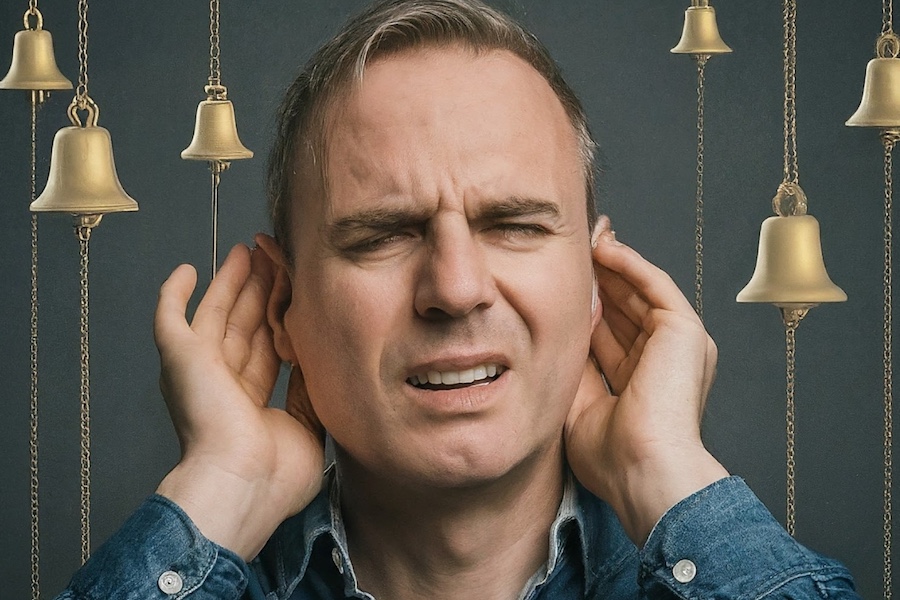
Musicians are suffering from damaged hearing at alarming rates. A new study quantified an occupational hazard that the music world has normalized. Ignore them at your patients' expense.
Why it matters
This isn’t a niche occupational ...

Musicians are suffering from damaged hearing at alarming rates. A new study quantified an occupational hazard that the music world has normalized. Ignore them at your patients' expense.
This isn’t a niche occupational ...
Nearly one in five adults with tinnitus have reduced hours or quit their jobs. Research published in Brain Sciences by Anglia Ruskin University concludes that tinnitus is more than an annoyance: it's a career-ender for some.
Tinnitus, the nagging sound of ringing or buzzing in the ears with no external source, impacts millions worldwide. Until now, doctors couldn't objectively measure how much this condition bothers patients. Researchers at Mass General Brigham have discovered ...
For nearly two centuries, doctors have noticed that patients often report significant psychological stress before developing tinnitus or hyperacusis (noise sensitivity). Now, researchers are exploring how chronic stress might contribute to these conditions—even ...
You’re not alone if you have tinnitus (ringing in the ears): 14% of adults experience it. New research suggests what you eat might influence your risk. The study suggests a few simple dietary tweaks could offer relief.
Tinnitus ...
The Hearing Health Foundation has launched a series of public service announcements, “Protect Your Ears.” The goal is changing how the public understands healthy hearing.
Here's the third of four PSAs in the series, "A ringing or buzzing ...
For the first time since 1803, two broods of cicadas have synchronized their 13- and 17-year emergence in Northern Illinois. Trees pulse with their mate-attracting racket.
The collective mating calls of cicadas can reach ...
Fifteen percent of Americans—around 50 million people—experience tinnitus or ringing in the ears.
New research shows that training your brain using a smartphone app can reduce tinnitus, the perception of sound without an external source.
Tinnitus is irritating and intrusive and can't be turned off as long as the brain focuses on it—and focusing ...
New research brings hope if you’re tormented by tinnitus (ringing in the ears). Researchers at the Massachusetts Eye and Ear have linked tinnitus to a loss of nerve fibers in the auditory nerve.
Somatic tinnitus is associated with body movement and posture. It is caused by the auditory system's interaction with sensory impulses from muscles, joints, and nerves in the head and neck. The intensity of the sounds it creates often varies.
Diverse ...
Researchers at the University of Michigan have developed a bi-sensory treatment for tinnitus.
Researchers from the University of Southern Denmark have found that living near a busy road increases the risk of developing tinnitus.
Tinnitus can sound like ringing, buzzing, whooshing, humming, hissing, throbbing, and even singing. Tinnitus can be temporary or chronic, but it's always produced by your brain, not your ears.
What you think about something affects how you feel about it.
Imagine this: A friend is coming to your place so you can go on a walk together, but they don't show up on time. How you perceive them being late will affect you ...
Forty-five million Americans experience tinnitus, perceiving sound in one or both ears without an external source. In your online search for information about this annoying problem, you'll encounter many misconceptions and unproven remedies for tinnitus.
Let ...
Tinnitus is the perception of sound in one or both ears without an external sound source. Often described as ringing in the ears, people can also sense tinnitus as buzzing or hissing. It can vary in pitch, loudness, and consistency.
Tinnitus ...

Sertoma Speech & Hearing Centers
is a 501(c)(3). EIN: 36-2882864.
© 2024, Sertoma Speech & Hearing Centers

Crest Hill
P 630-633-5060
F 630-633-5064
Palos Hills
P 708-599-9500
F 708-599-2791