Musicians are suffering from damaged hearing at alarming rates. A new study quantified an occupational hazard that the music world has normalized. Ignore them at your patients' expense.
Why it matters
This isn’t a niche occupational hazard. A systematic review pooling data from 67 studies and over 28,000 musicians across 21 countries found significant unaddressed auditory damage. For 15.6% of musicians with tinnitus, the ringing never stops. That’s a career consequence, not a temporary inconvenience.
"What we really need now is more personal, musician-centered risk profiling so we can offer practical, tailored advice that helps artists protect their hearing without sacrificing the music they love." — Dr. Shaun Nguyen, Medical University of South Carolina
Assumptions, assumptions
The industry long considered classical musicians safer than their pop and rock counterparts. Symphony halls feel quieter than stadium stages. The gear is acoustic, not amplified. That should matter.
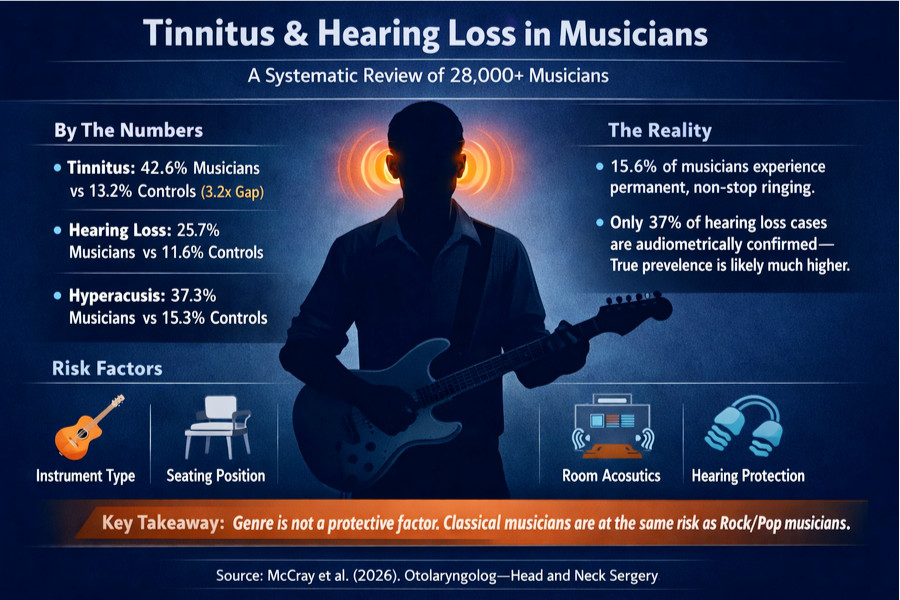
It doesn't. The study found no significant difference in auditory symptom rates between classical and pop/rock musicians. Genre is not a protective factor. A violinist in front of the brass section has the same risk as a guitarist in a club. Where you sit matters more than the stage.
What drives the risk:
-
Specific instrument type
-
Seating position in an ensemble
-
Room acoustics
-
Hearing protection habits
By the numbers
Compared to non-musicians, the gaps are not marginal. They’re structural.
-
Tinnitus: 42.6% of musicians vs. 13.2% of controls — a 3.2× gap
-
Hearing loss: 25.7% of musicians vs. 11.6% of controls
-
Hyperacusis: 37.3% of musicians vs. 15.3% of controls
-
Permanent tinnitus: 15.6% of affected musicians
-
Audiometrically confirmed hearing loss: only 37% of cases
A difficult truth
The real prevalence is likely worse than reported. Audiometric testing confirmed only 37% of hearing loss cases. The remaining 63% relied on self-report. In short, 25.7% hearing loss prevalence is the minimum. The confirmed floor. The actual number is higher.
The challenge
Dr. Nguyen calls for "musician-centered risk profiling" instead of generic public health guidance. The current clinical care model doesn't account for individual risk. Most musicians never receive routine hearing assessments, and preventive counseling is rare.
The takeaway
The assumption that hearing damage is someone else's problem needs to go. Over 40% of musicians have tinnitus. That is not background noise. It's a signal.
If you’re a musician, ask your doctor for an audiometric screening at your next visit.
Protect your hearing, preserve your peace of mind
If you're experiencing tinnitus, hyperacusis, or hearing changes, our free 15-minute hearing screening with an audiologist will help you:
- Understand your current hearing health
- Identify potential stress-related auditory issues early
- Access resources for managing tinnitus and hearing concerns
- Maintain your quality of life and mental well-being
Schedule your free screening today and take the first step toward better hearing health.
★ Call 708-599-9500 to schedule your consultation.
★ For facts about hearing loss and hearing aid options, grab your copy of The Hearing Loss Guide.
★ Sign up for our newsletter for the latest on Hearing aids, dementia triggered by hearing loss, pediatric speech and hearing, speech-language therapies, Parkinson's Voice therapies, and occupational-hearing conservation. We publish our newsletter eight times a year.
Don't let untreated hearing loss spoil your enjoyment of life.
Crest Hill, IL - 630-633-5060 | Palos Hills, IL - 708-599-9500