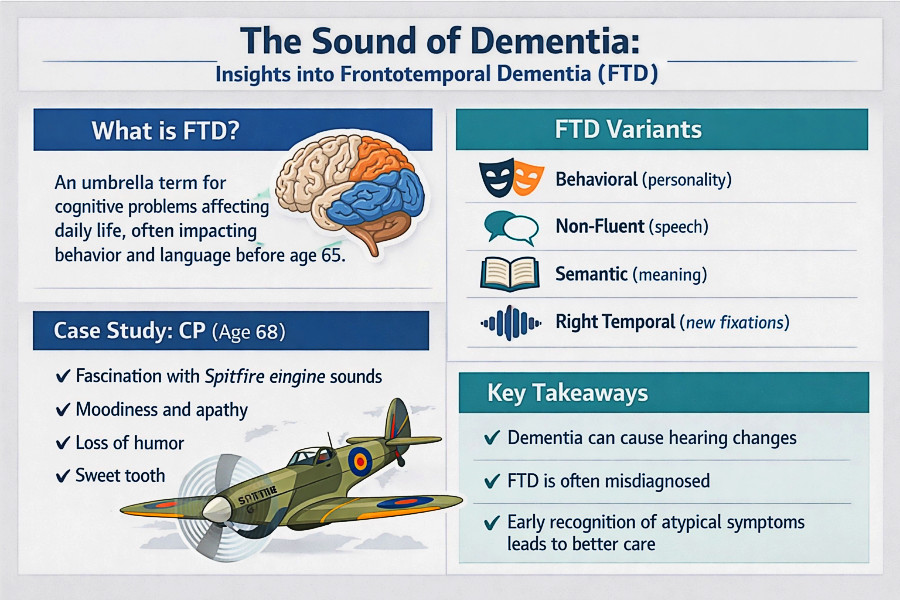
A 68-year-old man named "CP" would drop everything, run outside, and weep with joy whenever a Spitfire flew over his house. He'd never cared about planes before. It wasn't nostalgia. It was a rare, barely-classified form of dementia unrecognized by most doctors.
Why it matters
Most of us picture dementia as memory loss, but CP had no memory or language problems. Frontotemporal dementia (FTD) rarely starts with memory loss; it starts with identity. CP had something doctors are beginning to understand.
Assumptions, assumptions
We've known for some time that hearing loss increases the risk of developing dementia. In CP's case, however, it was the other way around. His abnormal relationship with sound developed after the disease began. The dementia changed his hearing.
The big picture
Dementia is an umbrella term. Alzheimer's gets the headlines, but there are multiple types, including FTD, which attacks the brain's frontal and temporal lobes and tends to strike before age 65.
FTD has three recognized variants:
- Behavioral — you change who you are: impulse, empathy, judgment
- Non-fluent — you lose the ability to form spoken words
- Semantic — you lose the meaning of words and concepts entirely.
Researchers argue there's a fourth variant. CP's case is their evidence.
Zoom in
CP's wife noticed something was wrong two years before his diagnosis. His symptoms weren't subtle; they were just misread:
- Became cold, apathetic, and short-tempered.
- Constantly interrupted; showed no grief at a family death.
- Developed a sudden sweet tooth; rejected any cover version of a song.
- Obsessed with chess and word searches
- Couldn't recognize faces but identified voices on the phone perfectly. That detail points to localized damage in the right temporal lobe.
Doctors classified CP with the behavioral variant FTD five years after symptoms appeared, but researchers argue that's the wrong call.
A closer look
They argue that CP had the right temporal variant of FTD, and brain scans confirmed that large portions of his right temporal lobe were gone. That region helps your brain read a room — facial expressions, tone of voice, unspoken social signals. When it degrades, the world becomes a place you can hear but no longer fully interpret.
The Spitfire obsession wasn't random. The right temporal variant triggers intense new fixations, such as specific sounds, foods, and music preferences. Not general interest. Surgical specificity. CP didn't react to other planes. Only Spitfires.
Reality check
Awareness of FTD, even among medical professionals, remains low. This contributes to diagnostic delays.
- The time from symptom onset to diagnosis for CP was five years.
- Early and accurate diagnosis is critical for managing symptoms and planning future care.
- The ongoing debate over the "right temporal variant" underscores the evolving understanding of FTD.
The takeaway
CP's story underscores the importance of recognizing the wide spectrum of dementia symptoms. This awareness is vital for:
- Earlier diagnosis.
- Developing tailored interventions.
- Understanding how dementia can change what people find pleasurable and their emotional responses. Intense obsessions or aversions are common in FTD.
The bottom line
When a patient's personality, emotions, and sensory preferences shift dramatically, but memory stays intact, don't default to Alzheimer's. FTD is routinely misdiagnosed, not just by families, but by doctors. The brain region driving the change may tell you something memory tests won't.
Protect your hearing, preserve your connection
Age-related or noise-induced hearing loss doesn't mean losing your social world or increasing your risk of dementia. Our free 15-minute hearing screening will help you:
- Understand your current hearing health
- Prevent communication barriers
- Stay engaged with loved ones
- Maintain your quality of life
Schedule your free screening today and rediscover the sounds that matter most.
★ Call 708-599-9500 to schedule your free screening.
★ For facts about hearing loss and hearing aid options, grab your copy of The Hearing Loss Guide.
★ Sign up for our newsletter for the latest on Hearing aids, dementia triggered by hearing loss, pediatric speech and hearing, speech-language therapies, Parkinson's Voice therapies, and occupational-hearing conservation. We publish our newsletter eight times a year.
Don't let untreated hearing loss spoil your enjoyment of life.
Crest Hill, IL - 630-633-5060 | Palos Hills, IL - 708-599-9500