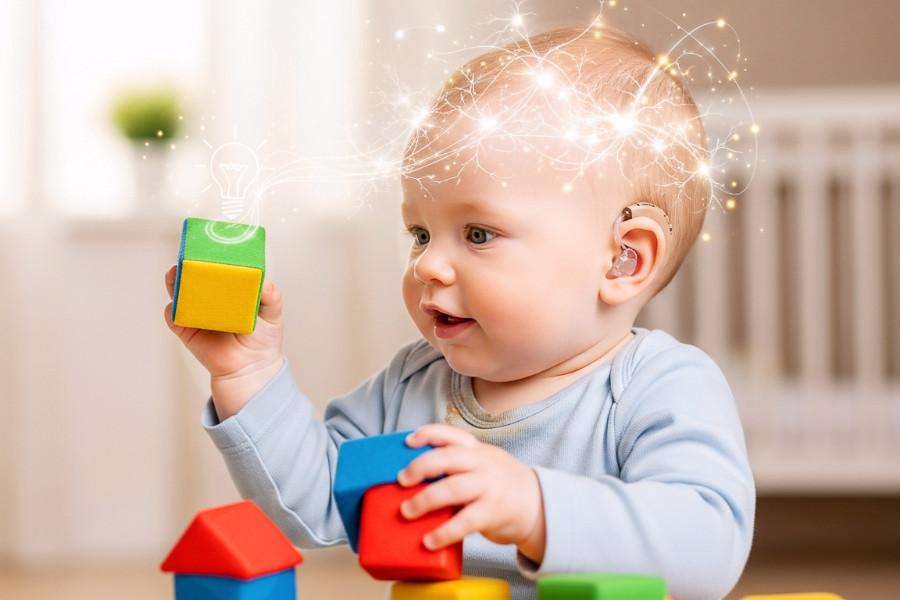
Scientists found that babies with hearing issues aren't just missing sounds; their brains develop differently. When babies are born deaf or struggle to hear, their brain's communication networks can misalign. The good news? There's a critical window in the first year of life to help get things back on course.
Early introduction of sound through hearing aids, cochlear implants, or sign language helps “rewire” babies’ brains, giving them the right tools and roadmap to build communication networks. The first 12 months are crucial because the brain is most flexible and ready to learn.
“This work reframes hearing loss as a brain-development issue, not just an ear issue. We now know that timely access to sound and language is key to keeping the brain’s communication networks on track.” —study authors
Why it matters
In the first year, without auditory or language input, the brain's left and right hemispheres fail to develop their usual balance.
-
The left hemisphere dominates speech processing within the first months of life.
-
Missing this developmental period affects communication and cognitive abilities for life.
The study
Researchers at the University of California, Merced, and Beijing Normal University used functional near-infrared spectroscopy (fNIRS) to measure communication efficiency between brain hemispheres in 112 infants aged 3-9 months: 52 with congenital hearing loss and 60 with typical hearing.
What they found
- Infants with sensorineural hearing loss lacked the usual left-hemisphere specialization that supports language and cognitive growth.
- Mild hearing loss allowed some normal brain patterns to develop.
- The most severe disruption was caused by moderate to profound hearing loss.
The big picture
This is a brain development problem. The tendency to concentrate certain functions in one hemisphere (brain asymmetry) forms the foundation for language, reasoning, and memory throughout life.
“Early exposure — whether through cochlear implants, hearing aids or sign language — is essential. The brain needs structured input to build the networks that will later support communication and learning.” —from the study
The proof
-
Earlier studies found that deaf infants with deaf parents who learn sign language from birth develop normal left-hemisphere organization.
-
Language access—not sound—drives healthy neural growth. The brain doesn't distinguish between spoken and signed language when building neural pathways.
What to know
Early treatment is critical. The options include:
-
Cochlear implants
-
Hearing aids
-
Sign language exposure
These treatments provide structured linguistic input that builds the brain's communication networks.
Unanswered questions
Researchers plan longitudinal studies to determine:
-
Can early intervention normalize long-term brain asymmetry?
-
How do interventions compare in effectiveness?
-
What is the optimal timing for each treatment?
-
How do sound, language, and cognition interact during development?
Final word
Every moment matters for a baby's brain development. If we treat hearing challenges early—within the first year—babies' brains can build strong communication networks.
Whether through hearing aids, cochlear implants, or sign language, giving babies a way to connect and understand language is like providing a roadmap for their brain's growth. Missing this window results in underdeveloped neural pathways.
The message is clear: early screening and ongoing support are crucial for a child's brain development.
Healthy children's hearing starts here
A lot can happen in 15 minutes. Safeguard your child's development with a free, 15-minute hearing screening conducted by our pediatric audiologists. This quick check provides peace of mind, establishes a healthy baseline, and ensures your child is on track for learning and social success.
★ Call 708-599-9500 to schedule.
★ For facts about hearing loss and hearing aid options, grab your copy of The Hearing Loss Guide.
★ Sign up for our newsletter for the latest on Hearing aids, dementia triggered by hearing loss, pediatric speech and hearing, speech-language therapies, Parkinson's Voice therapies, and occupational-hearing conservation. We publish our newsletter eight times a year.
Don't let untreated hearing loss spoil your child's intellectual and social development.
Crest Hill, IL - 630-633-5060 | Palos Hills, IL - 708-599-9500