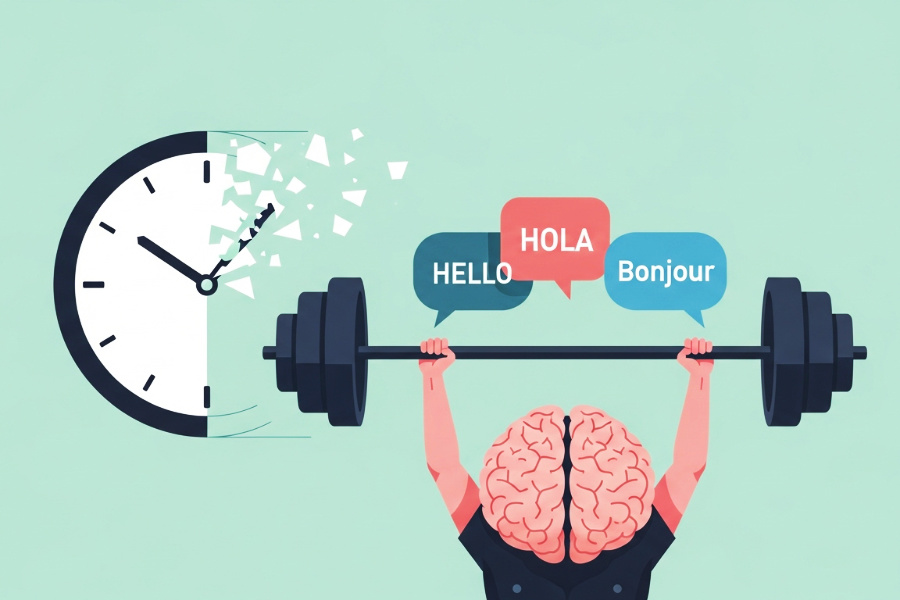
Learning a second language isn't just about navigating foreign menus: it might help your brain stay younger. Research suggests that being multilingual could slow the brain's aging process.
Why it matters
Multilingual people are half as likely to show signs of accelerated aging compared to monolinguals.
Robust results: The finding comes from a dataset of over 80,000 people, providing the strongest evidence yet that language skills slow cognitive decline.
The backstory
Scientists have long suspected that speaking multiple languages improves memory and attention.
-
Yes, but: Previous research had small sample sizes and "unreliable methods," leaving the scientific community divided on the benefits.
-
The shift: Neuroscientist Christos Pliatsikas says the new study is a significant jump for the field because its unrivaled scale settles the controversy.
How it works
Researchers analyzed data from 86,000 healthy participants aged 51 to 90 across 27 European countries.
-
They calculated a "biobehavioural age gap" for each person.
-
This score compares chronological age to a predicted age based on health, education, and lifestyle factors.
-
A large biobehavioural age gap indicates a person is aging faster—or slower—than expected.
The takeaway
You don't need to be multilingual to benefit. Susan Teubner-Rhodes, a cognitive psychologist at Auburn University, believes the results hint that picking up a second language or brushing off an old one could be worth it.

