Age-related hearing loss is common. Dementia is feared. Scientists long treated them as separate problems. New research says they share the same biological root.
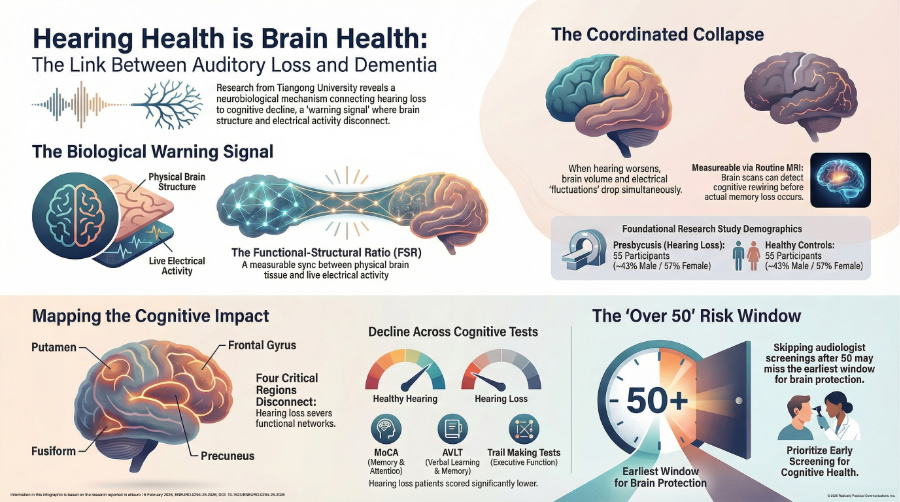
Researchers at Tiangong University and Shandong Provincial Hospital have identified a neurobiological mechanism, the Functional-Structural Ratio (FSR), linking age-related hearing loss to cognitive decline. This isn't a theory: the evidence shows up on brain scans.
Why it matters
Dementia risk has a new, measurable warning signal in your auditory system.
When hearing deteriorates, the brain's sync between structure and function breaks down, spreading into regions governing memory and decision-making: the functions that collapse in dementia.
A routine brain scan could tell your doctor if your hearing loss is rewiring your cognition, before a memory slips.
The study used MRI to measure two things simultaneously:
-
Gray matter volume (GMV) — physical brain tissue
-
Amplitude of low-frequency fluctuations (ALFF) — the brain's live electrical activity in those regions. It's like measuring whether the lights are still on.
When hearing worsens, both measures drop together. That coordinated collapse is what FSR captures. A lower FSR means the brain is reorganizing, and not in a good direction.
 Click the image to download this infographic.
Zoom in
Four brain regions are hardest hit.
-
Putamen and fusiform gyrus — process sound and speech
-
Precuneus and medial superior frontal gyrus — handle memory and executive function
These areas disconnect from the brain's functional networks as hearing loss advances.
Patients scored lower on the Montreal Cognitive Assessment (MoCA) — the same screening tool your doctor uses — performed worse on verbal learning tests (AVLT), and took longer to complete the Trail Making Test (TMT-A).
By the numbers
- 110 participants — 55 with presbycusis, 55 healthy controls.
- Researchers matched groups closely by sex (roughly 43% male, 57% female in each).
Reality check
This study doesn't prove that treating hearing loss prevents dementia.
The research is correlational and cross-sectional. The authors observe that FSR drops alongside cognitive scores. Researchers haven't tested whether hearing aids, cochlear implants, or auditory therapy reverse the damage. The study enrolled only 110 participants. Findings at this scale generate hypotheses but don't change clinical guidelines.
The bottom line
Hearing health is brain health.
Protect your hearing, preserve your connection
Age-related hearing loss doesn't mean losing your social world or increasing your risk of dementia. Our free 15-minute hearing screening will help you:
- Understand your current hearing health
- Prevent communication barriers
- Stay engaged with loved ones
- Maintain your quality of life
Schedule your free screening today and rediscover the sounds that matter most.
★ Call 708-599-9500 to schedule your free screening.
★ For facts about hearing loss and hearing aid options, grab your copy of The Hearing Loss Guide.
★ Sign up for our newsletter for the latest on Hearing aids, dementia triggered by hearing loss, pediatric speech and hearing, speech-language therapies, Parkinson's Voice therapies, and occupational-hearing conservation. We publish our newsletter eight times a year.
Don't let untreated hearing loss spoil your enjoyment of life.
Crest Hill, IL - 630-633-5060 | Palos Hills, IL - 708-599-9500