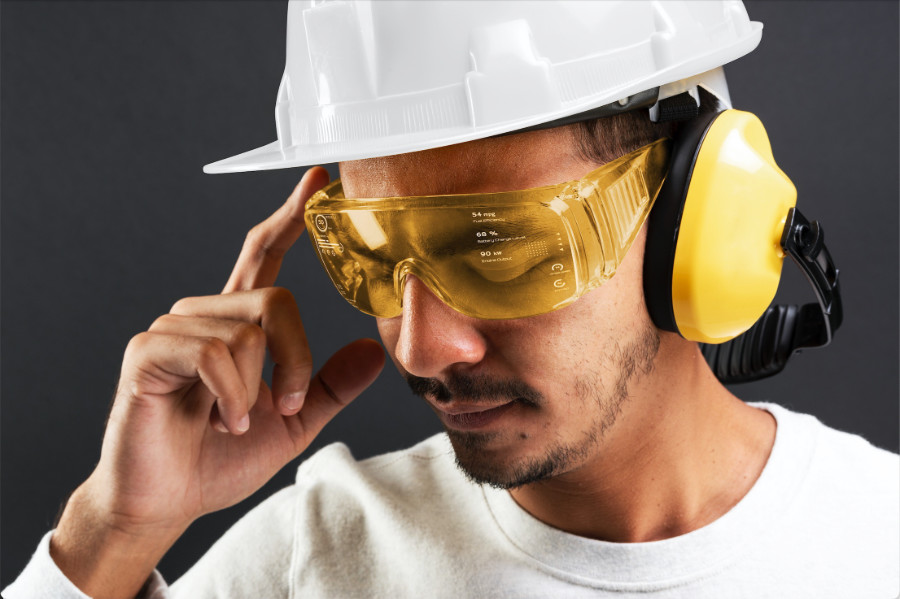
A simple hearing test at a specific frequency can predict whether a factory worker will lose their ability to understand speech, years before it happens. Researchers just proved it works in the largest occupational hearing loss prediction cohort ever assembled.
Why it matters
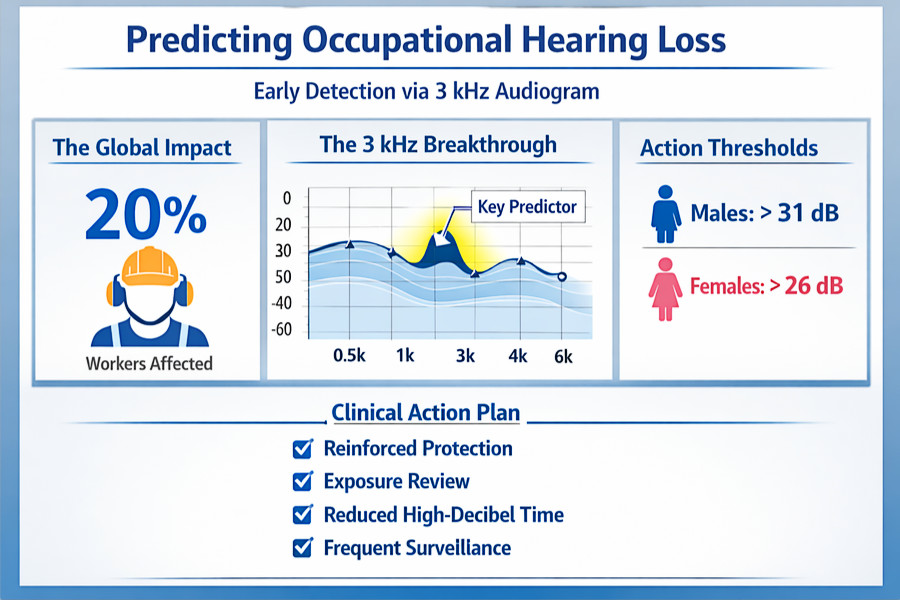
Noise-induced hearing loss affects roughly 20% of occupational workers globally. In most cases, by the time speech comprehension degrades, cochlear damage is permanent.
It drives social isolation, depression, cognitive decline, and increased mortality. Catching hearing loss early in workers who spend shifts in industrial noise means the difference between successful treatment and irreversible damage.
A closer look
The breakthrough is a single frequency on a standard audiogram.
Researchers applied two machine learning filters to all relevant variables to remove weak predictors and rank the remaining ones. Both filters independently produced the same result.
The winner was binaural hearing threshold at 3 kHz, ranked highest in both men and women.
The action thresholds:
- Males flag at BH3kHz above 31 dB and BH3_6kHz above 34 dB
- Females flag earlier and harder: both measures trigger above 26 dB
- Same test. Different risk profiles. Apply accordingly.
Combined with the 3–6 kHz average, age, and cumulative noise exposure, these four inputs power sex-specific prediction models that clinicians can apply right now. No genetic testing required.
By the numbers
- 9,669 shipyard workers enrolled across two sites in Shanghai
- 7,139 met final inclusion criteria after exclusions
- The models correctly distinguished high-risk from low-risk workers more than 80% of the time
Yes, but
The genetics angle did not pan out the way researchers hoped.
Adding 17 noise-induced hearing loss SNPs bumped model accuracy by roughly 2–3 percentage points.
Single-nucleotide polymorphisms or SNPs ("snips") are the most common type of genetic variation among people. In hearing, they act like tiny "typos" in your genetic code that can influence everything from how well you hear high frequencies to how likely you are to experience hearing loss as you age.
This improvement was only found in male training data, not the female data. As a result, the researchers eliminated genetic variants from the final clinical graphic calculator. Conclusion: Genetic screening is not ready for the occupational health floor.
The challenge
Occupational health directors outside Chinese heavy industry should treat these thresholds as directionally valid, not directly transferable.
- Chinese shipyard workers, 84% male
- Researchers excluded workers with ototoxic chemical exposure, middle-ear disease, or congenital hearing conditions
- The longitudinal sample was smaller than planned, and follow-up was shorter than ideal
The takeaway
The clinical action is straightforward.
Workers whose 3 kHz threshold crosses the sex-specific cut-off need four things:
- Reinforced hearing protection
- A formal review of their noise exposure hours
- Reduced time in high-decibel zones
- More frequent audiometric surveillance intervals.
At this 3 kHz threshold, cochlear damage is detectable but has not yet compromised the critical speech frequencies (around 500-4000 Hz). This early detection window allows for targeted intervention before irreversible hearing loss occurs, when protective strategies can still effectively preserve the worker's long-term hearing capacity.
Protect your hearing, preserve the quality of your life
Noise-induced hearing loss doesn't mean losing your social life or increasing your risk of dementia. Our free 15-minute hearing screening will help you:
- Understand your current hearing health
- Prevent communication barriers
- Stay engaged with loved ones
- Maintain your quality of life
Schedule your free screening today and rediscover the sounds that matter most.
★ Call 708-599-9500 to schedule your free screening.
★ For facts about hearing loss and hearing aid options, grab your copy of The Hearing Loss Guide.
★ Sign up for our newsletter for the latest on Hearing aids, dementia triggered by hearing loss, pediatric speech and hearing, speech-language therapies, Parkinson's Voice therapies, and occupational-hearing conservation. We publish our newsletter eight times a year.
Don't let untreated hearing loss spoil your enjoyment of life.
Crest Hill, IL - 630-633-5060 | Palos Hills, IL - 708-599-9500