Millions of people watch birds for fun. Most of them have no idea they may be running a cognitive training program. Scientists now have the scans to prove it.
Why it matters
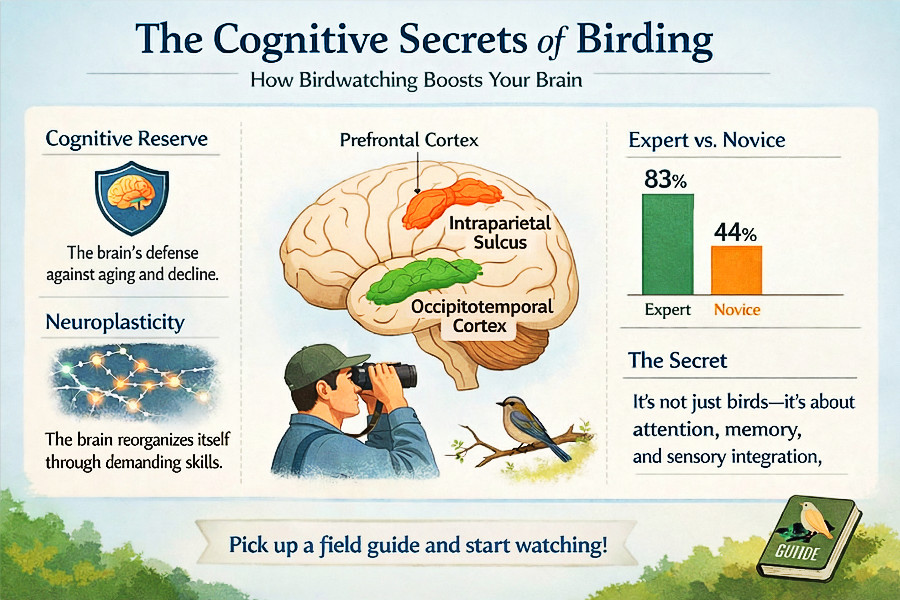
The brain has a defense mechanism against aging called cognitive reserve, which is the ability to adapt to damage and decline. Expert birdwatchers show measurably stronger cognitive reserve than novices. Brain scans show their neural regions governing attention, memory, and object identification are more structurally complex and more resistant to age-related decline.
The right hobby may be an effective tool for long-term brain health.
The intrigue
It's not actually about birds.
Researcher Erik Wing at York University is direct on this point: there is nothing inherently special about birding itself. Any activity pulling on the same cognitive domains — attention, memory, sensory integration — should produce the same brain changes. The article notes that learning a language produces comparable effects. Birding just happens to hit all of them at once. The brain doesn't care what you're studying, only that you're pushing it hard.
Yes, but
This study is a snapshot. One scan. One moment in time.
The study cannot separate cause from selection effect. Do birders build better brains, or do people with certain brain wiring gravitate toward birding? Wing says only repeated scans over months or years will settle it. Lifestyle factors common among birders, such as outdoor activity and social engagement, could also be driving the changes. McGill's Robert Zatorre calls cognitive reserve still disputed. This paper, he says, adds meaningful evidence.
How It Works
When you practice a demanding skill repeatedly, the brain reorganizes itself, strengthening and streamlining relevant pathways. This is neuroplasticity. It induces structural changes in the auditory brain regions of professional musicians. Athletes show the same adaptations in motor areas. Wing's team found the same principle applying to a skill most neuroscientists hadn't thought to study.
Birding recruits attention, memory, visual processing, and object identification all at once. That combination is what makes it potent.
By The Numbers
The test wasn't easy. Participants viewed each bird image for less than 4 seconds, then identified it from a lineup of four visually similar species repeated 72 times.
Wing scanned 48 hobbyist birders, half experts, half novices, aged 22 to 79, matched for sex, age, and education.
-
Experts correctly identified 83% of local species and 61% of non-local ones.
-
Novices hit 44% accuracy across the board.
- Three brain regions were activated in experts but not novices during non-local identification, namely, the bilateral prefrontal cortex, bilateral intraparietal sulcus, and the right occipitotemporal cortex
Expert birders showed greater structural complexity and organization in these same regions. Age-related decline hit both groups. Experts just weathered it better.
The Bottom Line
The brain responds to what you demand of it. Birding demands a lot. You don't need a research grant or visit a clinic to start building cognitive reserve. You need a field guide and somewhere to walk. The science says that's enough to begin.
Pick up a field guide.
Protect your hearing, preserve your connection
Untreated age-related or noise-induced hearing loss increases your risk of dementia. Our free 15-minute hearing screening will help you:
- Understand your current hearing health
- Prevent communication barriers
- Stay engaged with loved ones
- Maintain your quality of life
Schedule your free screening today and rediscover the sounds that matter most.
★ Call 708-599-9500 to schedule your free screening.
★ For facts about hearing loss and hearing aid options, grab your copy of The Hearing Loss Guide.
★ Sign up for our newsletter for the latest on Hearing aids, dementia triggered by hearing loss, pediatric speech and hearing, speech-language therapies, Parkinson's Voice therapies, and occupational-hearing conservation. We publish our newsletter eight times a year.
Don't let untreated hearing loss spoil your enjoyment of life.
Crest Hill, IL - 630-633-5060 | Palos Hills, IL - 708-599-9500