Children now spend 7.5 hours daily on screens—an all-time high. That's 52.5 hours weekly, well over the safe listening limit. Everyone talks about anxiety and depression. But hearing damage? Barely discussed.
Why it matters
Between 13% and 17% of students 12-19 already have measurable hearing loss from noise exposure. That's one in six to eight middle and high schoolers walking around with damaged hearing.
By the numbers
- 85 decibels: Hearing damage threshold
- 75 decibels: WHO's recommended max for children (vacuum cleaner volume)
- 40 hours weekly: Maximum safe listening time at that volume
- Two-thirds of parents report their children use headphones or earbuds
But children regularly exceed both the volume limit and the 40-hour weekly cap through daily device use alone.
The problem
Devices marketed as "kid safe" reach volumes well above 85 decibels, the damage threshold.
- Children assume invincibility, believing loud sounds can't harm them. Particularly dangerous when they're wearing headphones for hours during gaming, streaming, or online learning.
- Most parents believe "headphones are fine as long as the volume isn't too loud", but they can't gauge when sound crosses safe threshold.
- It's not just screens. Schools add to the problem. For example, nearly three in four adolescents face loud noise exposure for over 15 minutes every day.
The big picture
Hearing loss is more serious than missing a few words.
- Students with hearing loss underperform their peers academically. Mild to moderate hearing loss undermines learning capacity, deficits that compound into lower grades.
- Brain scans show hearing loss accelerates brain atrophy (loss of brain cells and tissue).
- Untreated hearing loss increases dementia risk by 7%. One study links hearing loss to up to 32% of dementia cases.
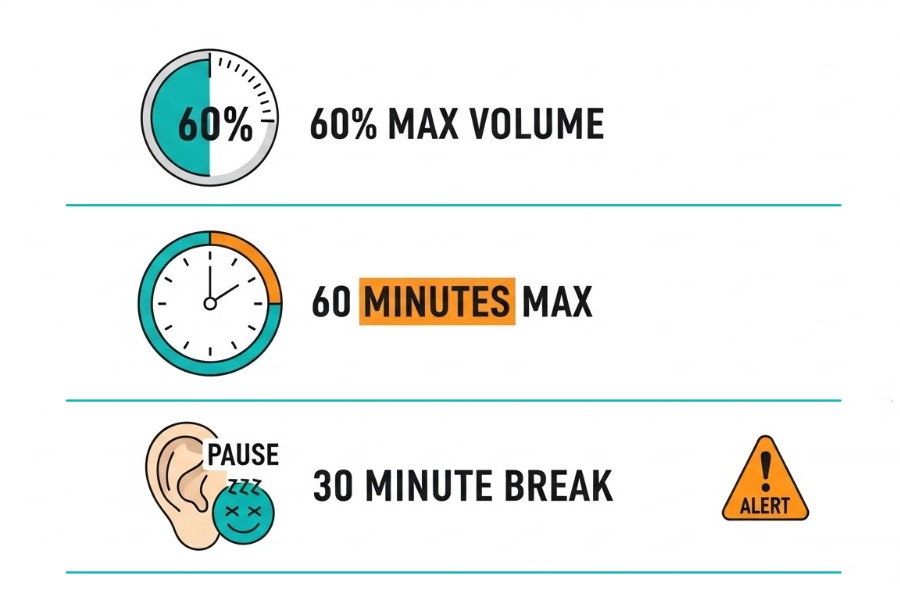
Follow The 60-60 Rule
A difficult truth
Hearing loss damage is permanent. Sound waves destroy cells that transmit signals to the brain.
Reality check
Federal agencies fail to enforce pediatric noise standards. The Consumer Product Safety Commission doesn't require toy manufacturers to label products exceeding safe thresholds or design with children's hearing health in mind.
What parents can do
- The American Academy of Otolaryngology recommends the 60-60 rule. Listen at 60% maximum volume for under 60 minutes, then take 30-minute breaks.
- Children should use earplugs at concerts and sporting events where noise easily exceeds safe levels.
- Watch for signs: Children may not report hearing loss symptoms themselves, making parental vigilance vital.
The bottom line
We obsess over mental health effects while a generation risks permanent hearing loss that undermines learning, connection, and long-term brain health.
Check your kid's volume settings tonight.
Healthy children's hearing starts here
A lot can happen in 15 minutes. Safeguard your child's development with a free, 15-minute hearing screening conducted by a specialist in pediatric audiology. This quick check provides peace of mind, establishes a healthy baseline, and ensures your child is on track for learning and social success.
★ Call 708-599-9500 to schedule.
★ For facts about hearing loss and hearing aid options, grab your copy of The Hearing Loss Guide.
★ Sign up for our newsletter for the latest on Hearing aids, dementia triggered by hearing loss, pediatric speech and hearing, speech-language therapies, Parkinson's Voice therapies, and occupational-hearing conservation. We publish our newsletter eight times a year.
Don't let untreated hearing loss spoil your child's intellectual and social development.
Crest Hill, IL - 630-633-5060 | Palos Hills, IL - 708-599-9500