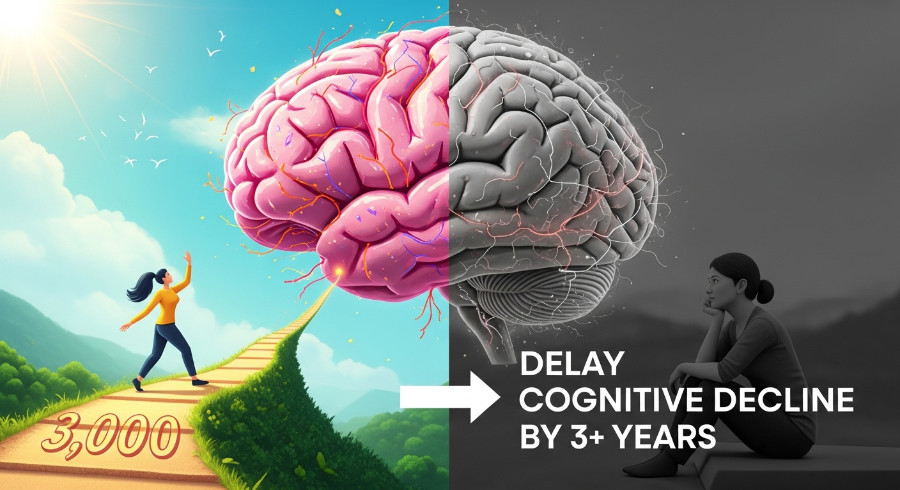
New Harvard research reveals that people with early molecular signs of Alzheimer's don't need to run marathons to protect their minds. Taking as few as 3,000 steps daily can delay cognitive decline by three years or more.
The context: Forget the 10,000 steps daily goal that feels unattainable for older adults. This research shows you need far less to make a difference.
Why it matters
This modest activity level, 3,000 steps daily, proved effective for 296 participants tracked over 14 years, but only for those with high amyloid-β levels, a plaque that signals increased Alzheimer's risk. This finding identifies who benefits most: people with biological warning signs before symptoms. The highest-risk group has low activity levels and high amyloid-β.
A closer look
The Harvard Aging Brain Study monitored participants aged 50–90 using pedometers, cognitive tests, and brain scans. At the start, none of the participants showed cognitive impairment (memory loss, difficulty thinking), allowing researchers to watch how activity affected the disease from its earliest stage up to 14 years.
How it works
Brain scans revealed that physical activity slows tau protein—a substance that tangles in brain cells—from accumulating. Tau is closely linked to cognitive decline in Alzheimer's. Notably, amyloid-β continued building up regardless of activity levels. This suggests exercise protects the brain through the tau pathway.
By the numbers
- 3,000–5,000 daily steps = 3-year delay in decline
- 5,000–7,500 daily steps = 7-year delay in decline
- No additional benefit above 7,500 steps.
The catch
Exercise only helped participants with elevated amyloid-β levels. Those with low levels saw no cognitive benefit from increased activity. Their low amyloid-β meant low Alzheimer's risk, making exercise less relevant for cognitive protection.
"They're the most likely to decline over time, and a good population to intervene and keep them from being sedentary," —Jasmeer Chhatwal, MD, PhD, co-author and a memory disorders specialist at Harvard Medical School
The takeaway
You don't need to do 10,000 steps a day—a goal many older adults find unattainable.
"The very encouraging takeaway is that even a little bit of exercise seems to help," —Wai-Ying Wendy Yau, MD, a physician-scientist specializing in memory disorders at Harvard Medical School
Final word
For those showing molecular signs of Alzheimer's, adding a daily walk means maintaining cognitive function and mental clarity for years longer, even for participants in their 80s and 90s.