Research links hearing loss to reduced brain volume and a 71% higher risk of dementia, especially in people with the APOEε4 gene variant. Wearing hearing aids reduces this risk.
Why it matters
The APOEε4 gene variant, carried by about 25% of the population, is the strongest genetic risk factor for Alzheimer's disease. If you carry this gene and have hearing loss, your dementia risk triples compared to those with normal hearing.
The backstory
Researchers analyzing Framingham Heart Study data examined MRI brain scans and cognitive assessments of 1,600 participants, including 900 adults aged 60 or older. They tracked participants for up to 15 years, monitoring for signs of dementia.
By the numbers
- 13% of the study participants developed dementia over 15 years (77% had Alzheimer's)
- Those with mild hearing loss had a 71% higher dementia risk compared to those with normal hearing, a bigger risk increase than smoking adds to lung disease
- APOEε4 carriers with hearing loss had a threefold greater dementia risk
- The risk increased with age—those over 70 with hearing loss showed the steepest cognitive decline
A closer look
As hearing worsened, brain health declined. Participants with mild hearing loss had more white matter hyperintensities (bright spots on brain scans indicating small areas of damage from reduced blood flow). "Bright spots" are markers of vascular aging.
Those with mild hearing loss also had measurably smaller hippocampus and temporal lobe volumes—regions critical for memory and language processing.
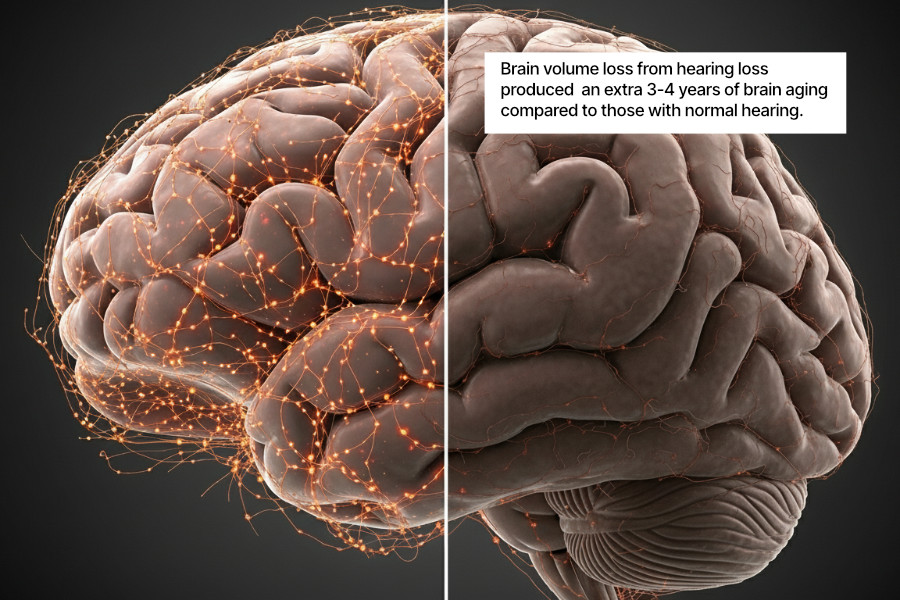
Brain volume loss equaled an extra 3-4 years of aging compared to those with normal hearing.
How it works
Hearing loss accelerates brain aging through three pathways:
Structural damage: Microvascular damage (tiny blood vessel changes that reduce oxygen and nutrient delivery to brain cells) affects both the inner ear and brain. Even after adjusting for vascular risk factors like high blood pressure, diabetes, and smoking, the link persisted—pointing to additional mechanisms.
Cognitive load: Straining to decode sounds exhausts mental resources needed for memory formation.
Social isolation: Communication difficulties lead to reduced social engagement, a known dementia risk factor.
The takeaway
- Treating hearing loss improves communication, preserves memory, and reduces dementia risk
- Wearing hearing aids supports brain health—one 2023 study found hearing aid users had a 48% lower rate of cognitive decline over three years
- Audiologists recommend baseline hearing tests starting at age 50, or earlier if you notice changes
Reality check
Researchers conducted an observational study (meaning it found associations but cannot prove cause-and-effect) with only a few APOEε4 carriers. More research is needed to fully understand the relationship between hearing loss, brain health, and dementia.
Not everyone with hearing loss develops dementia since many factors influence risk. But treating hearing loss is one of the few risk factors you can control.
The bottom line
Age-related hearing loss typically begins in your 50s but often goes unnoticed for years. Don't dismiss it as normal aging—early detection matters for your brain health.
Signs to watch for: asking people to repeat themselves, difficulty following group conversations, or family members complaining about TV volume.
If you notice these changes, get your hearing screened. Hearing aids do more than improve hearing—they protect your brain and keep you socially connected as you age.
Protect your hearing, preserve your connections
Age-related hearing loss doesn't mean losing your social world or increasing your risk of dementia. Our free 15-minute hearing screening will help you:
- Understand your current hearing health
- Prevent communication barriers
- Stay engaged with loved ones
- Maintain your quality of life
Schedule your free screening today and rediscover the sounds that matter most.
★ Call 708-599-9500 to schedule your free screening.
★ For facts about hearing loss and hearing aid options, grab your copy of The Hearing Loss Guide.
★ Sign up for our newsletter for the latest on Hearing aids, dementia triggered by hearing loss, pediatric speech and hearing, speech-language therapies, Parkinson's Voice therapies, and occupational-hearing conservation. We publish our newsletter eight times a year.
Don't let untreated hearing loss spoil your enjoyment of life.
Crest Hill, IL - 630-633-5060 | Palos Hills, IL - 708-599-9500