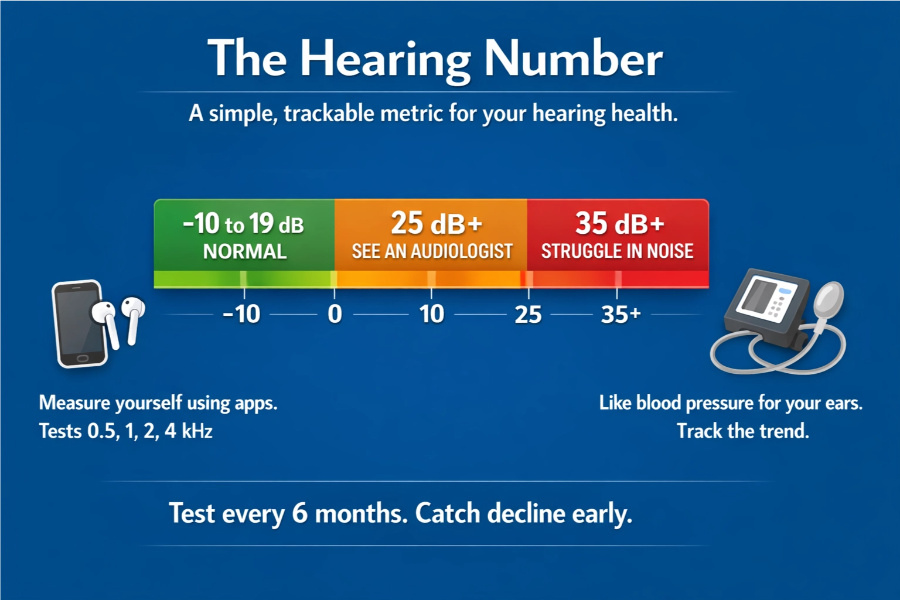
Hearing now has a simple, trackable metric, such as blood pressure or 20/20 vision. It's called the Hearing Number, and thanks to Johns Hopkins Bloomberg School of Public Health millions of people can now measure it themselves using smartphones and AirPods.
Why it matters
Unlike gradual vision changes, most people ignore hearing loss until it's severe. A universal number makes decline visible and measurable before communication becomes a daily struggle, affecting social engagement and cognitive health, according to research cited in the article.
What to know
The Hearing Number translates a clinical measurement (pure-tone average at four speech frequencies) into plain language. Lower is better.
- Values between -10 and 19 dB mean you hear normally.
- Value above 35 dB, you likely struggle to follow conversations in noisy restaurants.
How it works
Apps replicate what audiologists do in sound booths: play tones at various frequencies and volumes while you tap when you hear them. The results approximate what you'd get in an audiologist's sound booth for most people.
By the numbers:
-
120 million AirPods projected to sell globally in 2025
-
Apple added hearing tests to AirPods Pro in 2024.
-
Smartphone apps lose accuracy above 80 dB hearing loss.
-
Tests measure four frequencies: 0.5, 1, 2, and 4 kHz.
Johns Hopkins Bloomberg School of Public Health launched a free Hearing Number app with age-based comparisons in the U.S.
Click the image to download the Hearing Number Fact Sheet and Johns Hopkins' app.
The problem
Traditional hearing classifications hide progression. Someone whose hearing drops from 25 to 39 dB stays labeled "mild" under WHO definitions, even though their communication has declined.
These 15-dB jumps mask what's happening. You're asking people to repeat themselves more often, but your last test still says "mild," so you do nothing.
Reality check
These apps screen, they don't replace clinical diagnosis.
-
If your Hearing Number exceeds 25 dB or changes by over 10 dB, see an audiologist.
-
Results vary across devices and headphones. Background noise skews results.
-
Calibration remains "loose," so your results might vary by a few decibels depending on your headphones.
Yes, but
In regions with limited access to audiologists or those wanting convenient monitoring between checkups, the apps fill a critical gap. But abnormal results should trigger a professional visit. Audiologists now see patients arriving earlier with self-collected data, before hearing loss progresses to communication breakdown.
What audiologists do that apps can't:
-
Diagnose the cause of hearing loss (medical vs. age-related)
-
Fit and program hearing aids to your hearing profile
-
Refer you to ENT specialists if they detect tumors, infections, or other medical issues
-
Test speech comprehension in noise, not just tone detection
The big picture
Audiologists remain essential. Apps screen for hearing loss.
-
Audiologists diagnose the cause of hearing loss — ear infections, tumors, medication side effects, or age-related decline—and prescribe treatment.
-
The Hearing Number gets more people to professional care.
-
You can catch hearing decline early enough to adopt hearing protection, get a professional evaluation, and explore hearing aids with an audiologist before isolating yourself.
This mirrors home blood pressure cuffs.
-
Home monitors catch high readings. Physicians diagnose causes and prescribe treatment.
-
The same division of labor applies to hearing: apps detect changes, audiologists determine their cause, and the best treatments.
The bottom line
For decades, hearing loss hid in plain sight—no number to track, no way to self-monitor. A simple number and a smartphone test change this. You can finally own your hearing like your blood pressure.
-
Test yours once. Retest in 6 months.
-
Track the trend, not just the snapshot.
Prefer a professional hearing screening with an audiologist?
Age-related hearing loss doesn't mean losing your social world or increasing your risk of dementia. Our free 15-minute hearing screening will help you:
- Understand your current hearing health
- Prevent communication barriers
- Stay engaged with loved ones
- Maintain your quality of life
Schedule your free screening today and rediscover the sounds that matter most.
★ Call 708-599-9500 to schedule your free screening.
★ For facts about hearing loss and hearing aid options, grab your copy of The Hearing Loss Guide.
★ Sign up for our newsletter for the latest on Hearing aids, dementia triggered by hearing loss, pediatric speech and hearing, speech-language therapies, Parkinson's Voice therapies, and occupational-hearing conservation. We publish our newsletter eight times a year.
Don't let untreated hearing loss spoil your enjoyment of life.
Crest Hill, IL - 630-633-5060 | Palos Hills, IL - 708-599-9500