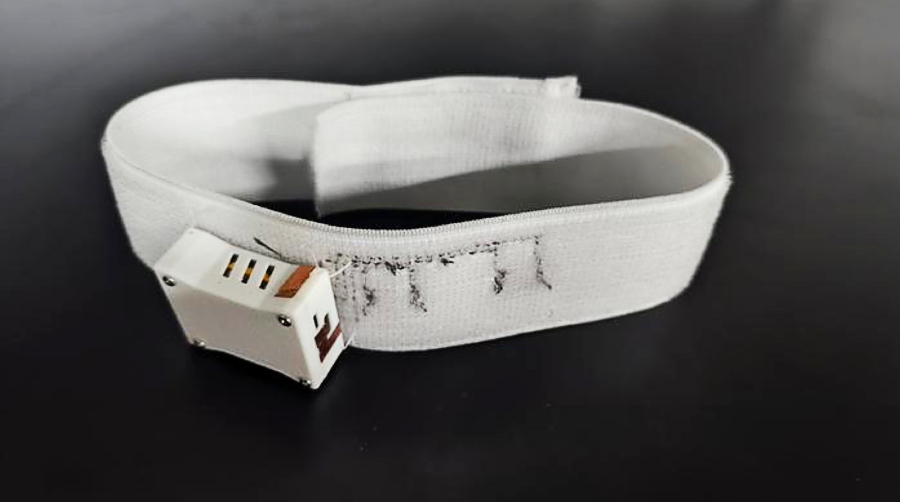
Researchers at the University of Cambridge solved a vexing problem: how to help stroke survivors communicate fluently without implanting brain electrodes. Their solution? A wearable choker called Revoice that reads throat vibrations and turns silently mouthed words into sentences.
Why it matters
About half of stroke patients lose the ability to speak clearly due to dysarthria, a condition where the brain-to-throat signal gets scrambled. They know what to say but cannot articulate it. Revoice lets them participate in real conversations during the months-to-year recovery period, especially for spontaneous dialogue where repetitive therapy drills fall short.
Current options are painfully slow (letter-by-letter spelling at 8-10 words per minute) or invasive (brain implants requiring neurosurgery). Revoice offers a middle path.
How it works
-
Graphene-coated textile sensors with a gauge factor above 100 detect throat strain as small as 0.1% when patients mouth words silently.
-
A separate sensor monitors pulse signals from the carotid artery to decode emotional state
-
Two AI agents work together: a Token Synthesis Agent corrects decoding errors through majority-voting, while a Sentence Expansion Agent uses GPT-4o-mini to generate contextual output.
-
Battery lasts a full day on a single charge; device is washable and connects via Bluetooth
-
Patients control expansion with two nods.
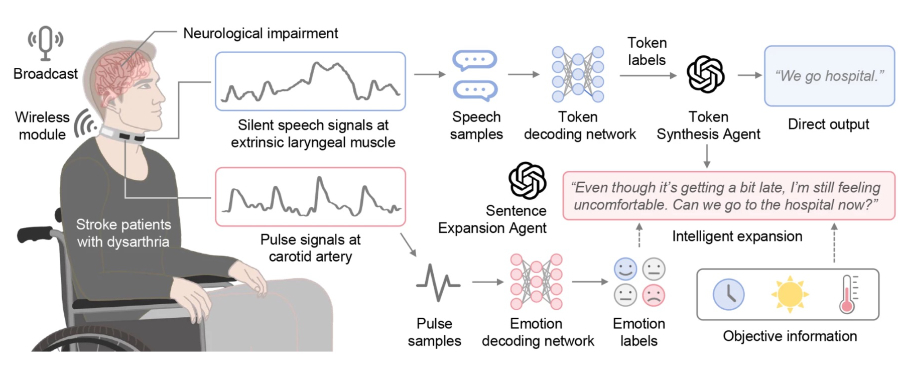 Illustration of how Revoice works provided by Cambridge University.
Zoom in
A patient mouths, "We go hospital." The AI detects elevated heart rate (frustration) and notes it's late at night. Output: "Even though it's getting a bit late, I'm still feeling uncomfortable. Can we go to the hospital now?"
By the numbers:
-
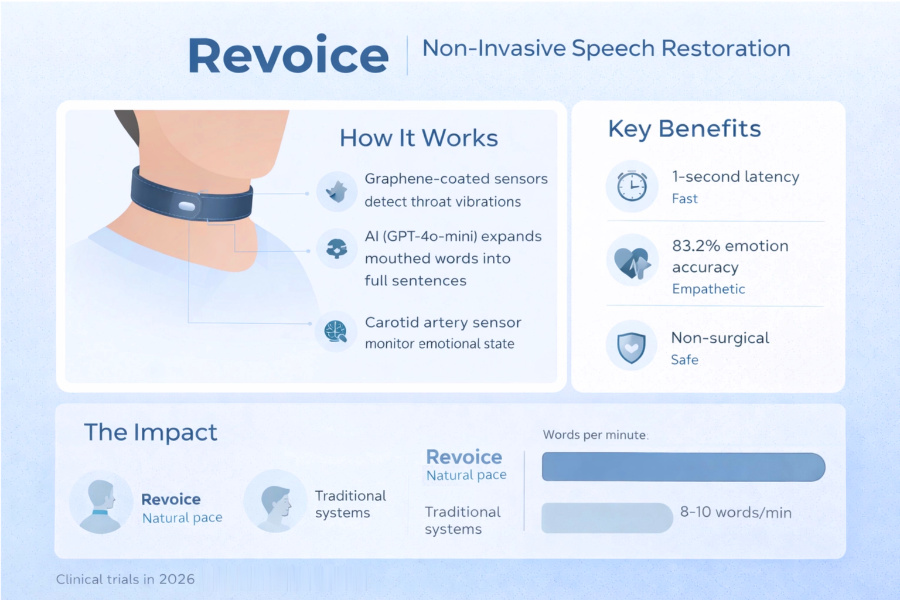
~1 second delay from mouthing words to hearing output
-
55% increase in patient satisfaction vs. basic word-only output
-
83.2% accuracy in detecting emotional states (neutral, relieved, frustrated)
-
4.2% word error rate and 2.9% sentence error rate in trials with five patients—average age 43, four men and one woman.
What makes it different
-
Traditional letter-by-letter spelling systems: ~8-10 words per minute
-
Revoice: Natural speaking pace with 1-second latency
-
Brain implants: Require neurosurgery; Revoice installs like wearing a necklace.
Yes, but: This isn't ready for widespread use.
-
Researchers tested the device on five Chinese-speaking patients.
-
The system currently handles only 47 words
-
The rigid circuit board made some patients uncomfortable for long-term wear.
-
Won't work for patients who can't mouth words (complete facial paralysis requires brain implants instead)
-
The device needs extensive clinical trials before commercial release.
The bottom line
Unlike existing assistive tech that feels clunky and unnatural, Revoice mimics natural conversation flow. It proves communication aids need not choose between "invasive but effective" and "safe but frustrating."
The Cambridge team plans English-language clinical trials in 2026 for native English-speaking dysarthric patients, supporting Parkinson's and ALS patients in future versions.

