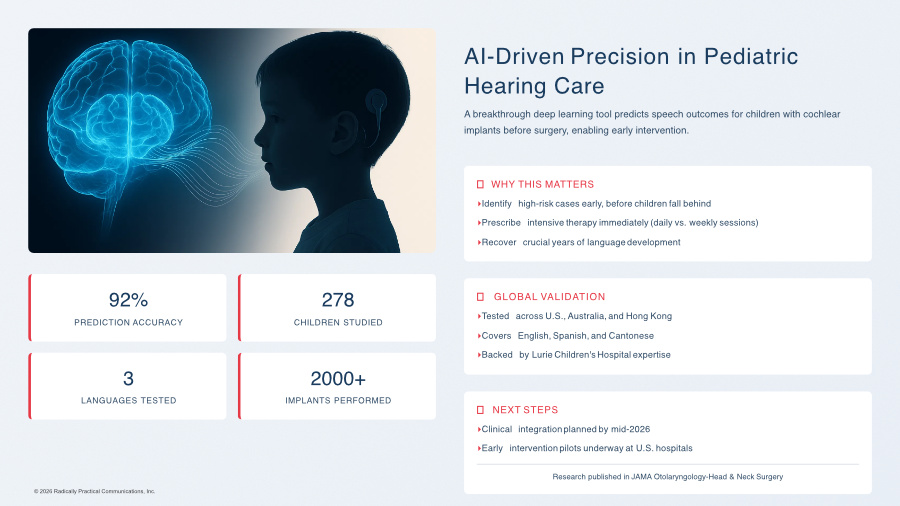
Researchers at Chicago's Lurie Children's Hospital created a new AI tool that predicts with 92% accuracy which deaf children will struggle with speech after cochlear implants before surgery. It reads pre-surgery brain scans using AI. The research, backed by $2M in NIH and Hong Kong grants, appears in JAMA Otolaryngology-Head & Neck Surgery.
Why it matters
Cochlear implants restore hearing for kids with severe hearing loss, but results vary. For example, some children achieve age-appropriate language by kindergarten, while others lag years behind despite identical implants and therapy schedules.
- Take an 18-month-old flagged as high-risk. Instead of waiting until age 3 to confirm she's falling behind, her family begins augmented therapy at 20 months, recovering two crucial years of language development.
- This new AI tool identifies high-risk children early, letting doctors prescribe intensive therapy (daily sessions instead of weekly, or adding sign language support alongside speech training) before they fall behind.
By the numbers:
-
92% prediction accuracy for outcomes 1-3 years post-surgery
-
278 children studied across Hong Kong, Australia, and the U.S.
-
3 languages tested: English, Spanish, and Cantonese
-
2,000+ implants performed at Lurie Children's Hospital since 1991
Yes, but: The study doesn't detail "intensified therapy" or provide cost estimates, information essential for hospitals deciding to adopt this tool. It proves prediction works, not that intervention solves the problem.
Why it works
Traditional machine learning struggles with messy, real-world data created by different MRI brands, varied radiologist protocols, and children speaking unrelated languages. This AI effectively managed all of it and outperformed traditional models across all measures.
How it works
Researchers trained a deep learning model on brain MRI scans before cochlear implant surgery. The model analyzes these scans and predicts whether a child will develop spoken language typically or need extra support.
"This is a 'predict-to-prescribe' approach," says Dr. Nancy M. Young, who directs Lurie Children's cochlear implant program. Young oversees one of the world's largest cochlear implant programs, with over 2,000 surgeries since 1991. Her team now pinpoints which kids need more help and acts early.
The context
Even with early implants, most deaf kids lag behind hearing peers in language development, a gap that's frustrated families for decades. The uncertainty isn't new: Families invest years in therapy, not knowing until age 4 or 5 whether their child will speak fluently.
What's next
Lurie Children's Hospital plans to integrate the AI tool into clinical practice by mid-2026. Other implant centers in the study are exploring licensing agreements.
The bottom line
AI won't replace audiologists or speech-language pathologists. It gives them foresight for the first time. Instead of waiting years to identify who is struggling, care teams can now mobilize resources from the start. Early intervention pilots using this model are underway at U.S. hospitals.
Healthy children's hearing starts here
A lot can happen in 15 minutes. Safeguard your child's development with a free, 15-minute hearing screening conducted by our expert audiologists. This quick check provides peace of mind, establishes a healthy baseline, and ensures your child is on track for learning and social success.
★ Call 708-599-9500 to schedule.
★ For facts about hearing loss and hearing aid options, grab your copy of The Hearing Loss Guide.
★ Sign up for our newsletter for the latest on Hearing aids, dementia triggered by hearing loss, pediatric speech and hearing, speech-language therapies, Parkinson's Voice therapies, and occupational-hearing conservation. We publish our newsletter eight times a year.
Don't let untreated hearing loss spoil your child's intellectual and social development.
Crest Hill, IL - 630-633-5060 | Palos Hills, IL - 708-599-9500