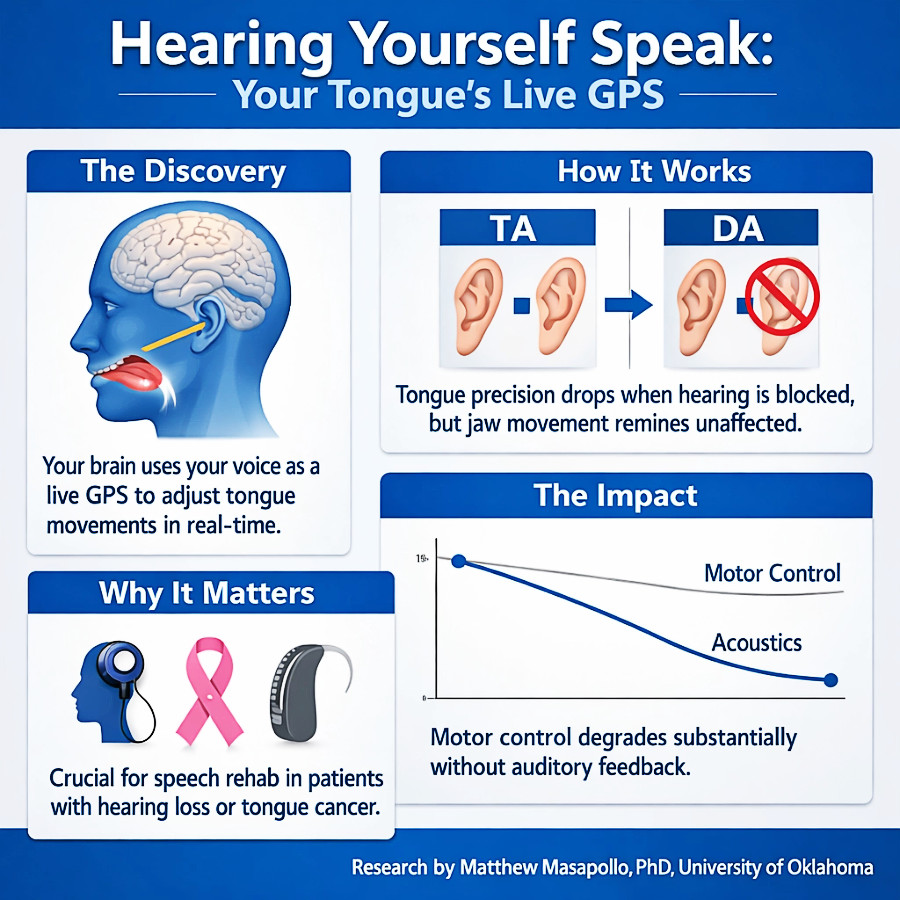
Your brain does something remarkable when you talk: it uses your voice as a live GPS, constantly adjusting your tongue’s movements to make speech smooth and accurate.
Why it matters
Researchers have kinematic evidence that auditory feedback governs tongue movement during speech, not just sound quality. This changes how clinicians approach speech rehabilitation for patients with hearing loss, cochlear implants, and tongue cancer.
“Speech feels automatic, but it’s one of the most complex motor skills that we routinely perform. A typical adult produces up to 16,000 words each day – that’s tens of thousands of precisely timed movements requiring precise coordination throughout the vocal tract. What we’ve shown in this study is that auditory information helps regulate the control of the movements.” —lead researcher, Matthew Masapollo, PhD, The University of Oklahoma
How it works
Participants spoke the sounds "ta" and "da" under two conditions: once while hearing themselves normally, and once with masked hearing. Small sensors tracked tongue and jaw movements in real time using electromagnetic articulography (EMA), to capture motion inside the vocal tract.
The result was surgically specific:
- Tongue-elevating movements became less precise when hearing was blocked.
- Jaw movements were unaffected.
- Motor control degraded substantially, not just acoustics.
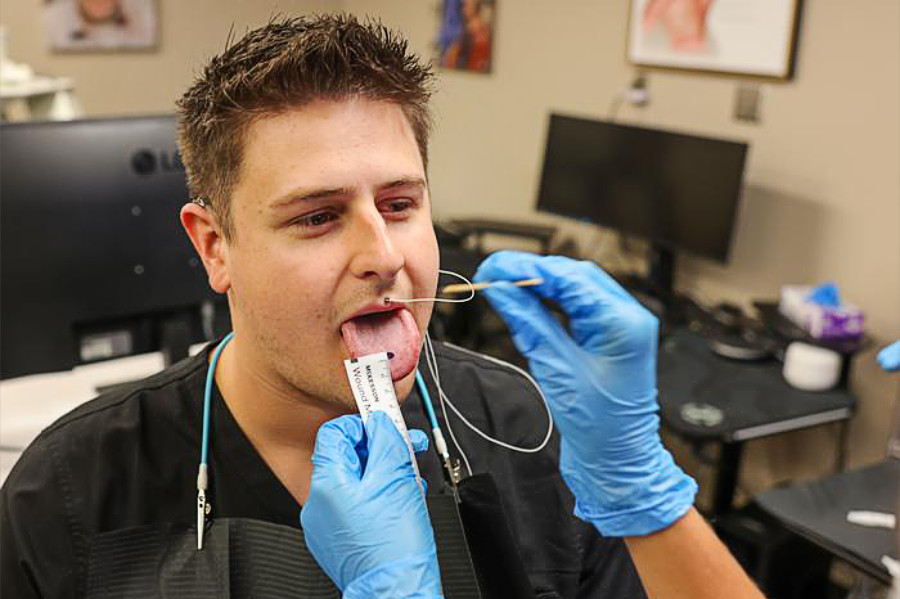 At the University of Oklahoma College of Allied Health, a researcher connects copper electrodes to the face of a person with a cochlear implant. The technology is called electromagnetic articulography. Credit: University of Oklahoma/Andrew Craig
A closer look
Why the tongue and not the jaw? The jaw rotates. It's mechanically simple. The tongue is almost infinitely malleable. Consider how well it dislodges food from your back teeth. That flexibility needs more sensory input to stay on target.
Dr. Masapollo noted that the brain doesn't fully pre-plan speech. It corrects on the fly, using what you hear to regulate the tongue's movement. A typical adult produces up to 16,000 words daily, requiring tens of thousands of precise tongue movements. The system works smoothly, making it feel automatic.
The problem
Cancer treatments attack this system from multiple angles:
-
Surgery removes tongue tissue and damages sensory nerves.
-
Radiation creates fibrosis, reducing tongue flexibility.
-
Chemotherapy can damage hearing — stripping away the auditory feedback the tongue depends on.
Each is damaging, but together they compound the problem.
Zoom in
-
Masapollo is now running a longitudinal study with tongue cancer patients at OU, tracking motor function before treatment and for three years after surgery and/or radiation.
-
Goal: map how different interventions degrade tongue control over time, so speech pathologists can intervene precisely.
The bottom line
Previous research asked people to listen to patients and rate their speech. This study examined the vocal tract and observed the tongue’s movements. Those are not the same thing.
- Perceptual ratings miss what EMA reveals.
- The hidden terrain between subjective perception and objective movement is where speech therapy has navigated without a map. This research offers precise GPS.
Concerned about your speech?
A screening with a speech-language pathologist will help you understand:
- Your current speech challenge
- Ways to prevent communication barriers
- Staying engaged with loved ones
- Maintaining your quality of life
★ Call 708-599-9500 to schedule your free screening.
★ For facts about speech-language pathology and treatment options, grab your copy of The Consumer's Guide to Speech-Language Pathology.
★ Sign up for our newsletter for the latest on Hearing aids, dementia triggered by hearing loss, pediatric speech and hearing, speech-language therapies, Parkinson's Voice therapies, and occupational-hearing conservation. We publish our newsletter eight times a year.
Don't let speech challenges spoil your enjoyment of life.
Crest Hill, IL - 630-633-5060 | Palos Hills, IL - 708-599-9500