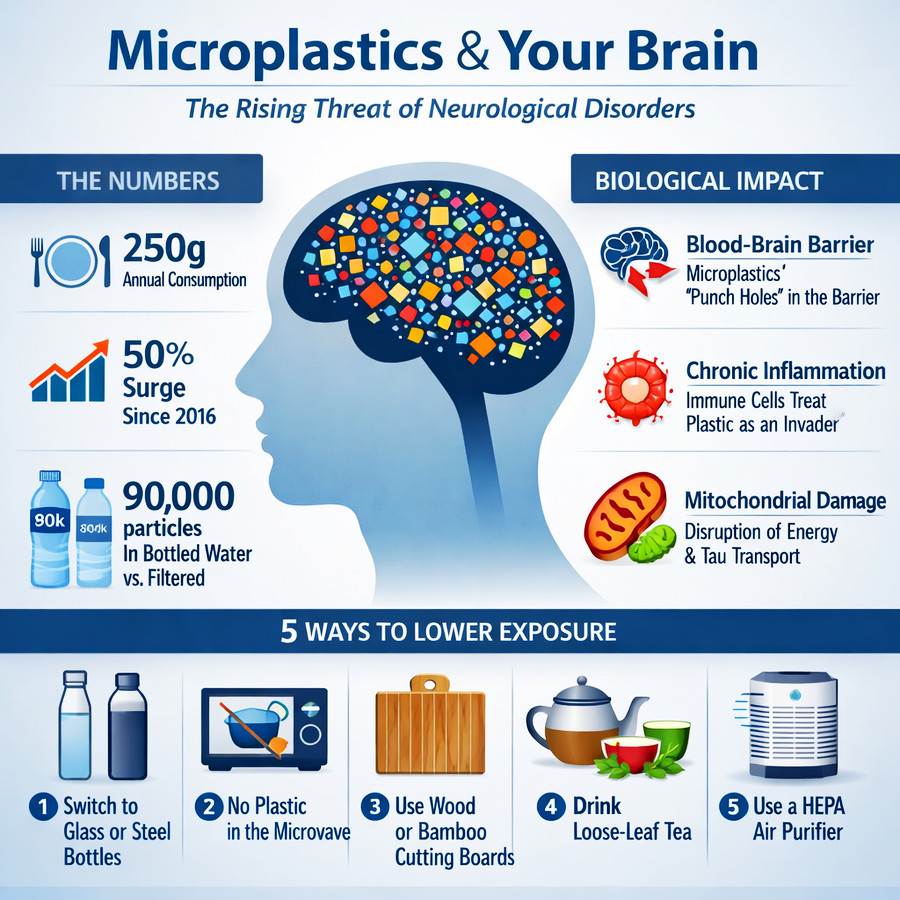
It's not science fiction: plastic is literally building up in human brains. A recent peer-reviewed study from the University of Technology Sydney and Auburn University found microplastic levels have surged 50% since 2016, potentially setting the stage for neurological disorders.
Why it matters
Brain tissue accumulates more microplastics than any other organ, including the kidneys and liver. A 2025 Nature Medicine study found significant plastic buildup in the immune cells and blood vessel walls of patients with dementia. We don't know if plastic causes dementia, but its presence is more prevalent in patients with dementia.
By the numbers
- Adults consume about 250 grams of microplastics annually, enough to cover a dinner plate.
- Bottled water exposes you to up to 90,000 more plastic particles per year than filtered tap water.
- A single plastic tea bag releases billions of microplastic particles into your cup.
- Polystyrene — the most-studied plastic in lab research — represents only 9.7% of global plastic production.
How it works
Researchers identified six biological pathways linking microplastics to Alzheimer's and six to Parkinson's:
- Microplastics punch holes in the blood-brain barrier, the membrane that keeps threats out of brain tissue.
- Brain immune cells treat plastic as an invader, triggering chronic low-grade inflammation, a feature of both diseases.
- Inside cells, microplastics reach the mitochondria and disrupt energy production, impairing tau protein transport and accelerating toxic tangle formation in Alzheimer's patients.
- A 2023 Science Advances study found nanoplastics directly accelerate the protein deposits that define Parkinson's disease.
Yes, but
No study has proven that plastic causes Alzheimer's or Parkinson's in humans. Most evidence comes from animal and cell models. Researchers call for long-term human trials that don't exist. Hold the panic, but don't dismiss this.
A difficult truth
The most-studied lab plastic covers less than 10% of what's out there. Polyethylene makes up 54.5% of global plastic production. Researchers barely understand it.
The takeaway
You can't eliminate exposure, but you can significantly lower it. The five most effective tactics are:
- Ditch plastic water bottles for filtered tap in glass or stainless steel.
- Stop heating food in plastic containers. Switch to glass or ceramic.
- Replace plastic cutting boards with hardwood or bamboo.
- Swap plastic tea bags for loose-leaf with a steel infuser.
- Run a HEPA air purifier at home.