Neuroscientists at Cambridge identified five "major epochs" of brain structure over a human lifetime. These phases—from childhood through late aging—are separated by four pivotal turning points where neural connections fundamentally reconfigure. This changes how we think, grow, and eventually decline.
Why it matters
The brain's structural journey is not a steady progression. It's defined by a few major turning points.
-
Identifying these eras provides critical context for when brains are most vulnerable to specific risks.
-
Vulnerabilities include learning difficulties in childhood, mental health disorders appearing around age 9, or dementia in later years.
-
Differences in brain wiring predict difficulties with attention, language, memory, and other behaviors.
What to know
Cambridge researchers studied the brains of 3,802 people between zero and ninety years old. They used MRI diffusion scans, which map connections by tracking how water molecules move through brain tissue.
-
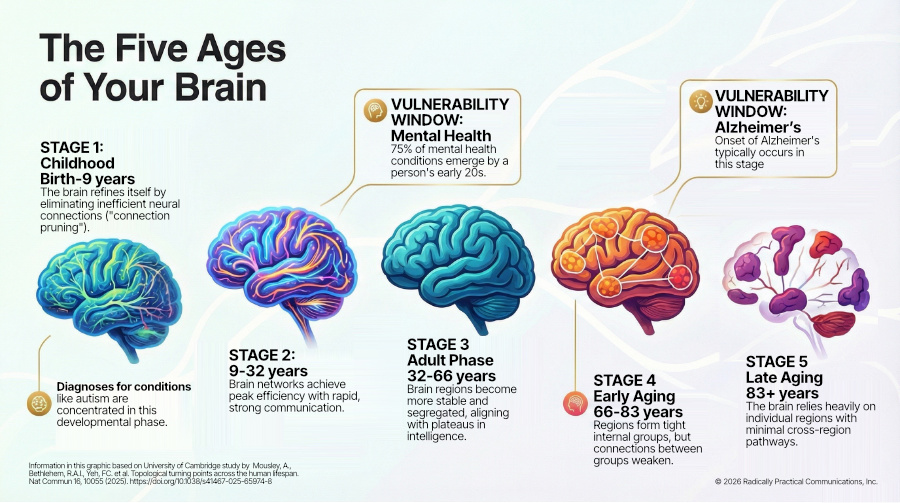
The first era, Childhood (Birth to 9), is defined by network consolidation as overproduced synapses are reduced.
-
During this time, grey and white matter grow rapidly, and cortical thickness peaks.
The Timeline
Four key ages mark the dramatic transition between phases:
-
Age 9: The first pivot point. This is when the brain transitions to the Adolescent phase and experiences a step-change in cognitive capacity.
-
Age 32: The strongest topological turning point of the entire lifespan. This marks the end of adolescence—the only era where neural efficiency increases.
-
Age 66: The start of the Early Ageing phase. This transition is often related to reduced connectivity as white matter degenerates, increasing risk for health conditions like hypertension.
-
Age 83: The final turning point. The brain enters the Late Ageing phase.
A closer look
The Adult era (32–66) is the longest, spanning over three decades.
-
Brain architecture stabilizes compared to previous phases, with no major turning points for thirty years.
-
This stability corresponds with a "plateau in intelligence and personality," based on other studies.
-
A key feature is increasing segregation—where regions slowly become more compartmentalized.
The bottom line
The final phase, Late Aging (beginning around age 83), features declining whole-brain connectivity. The structural architecture shifts from global to local, with an increased reliance on specific regions.