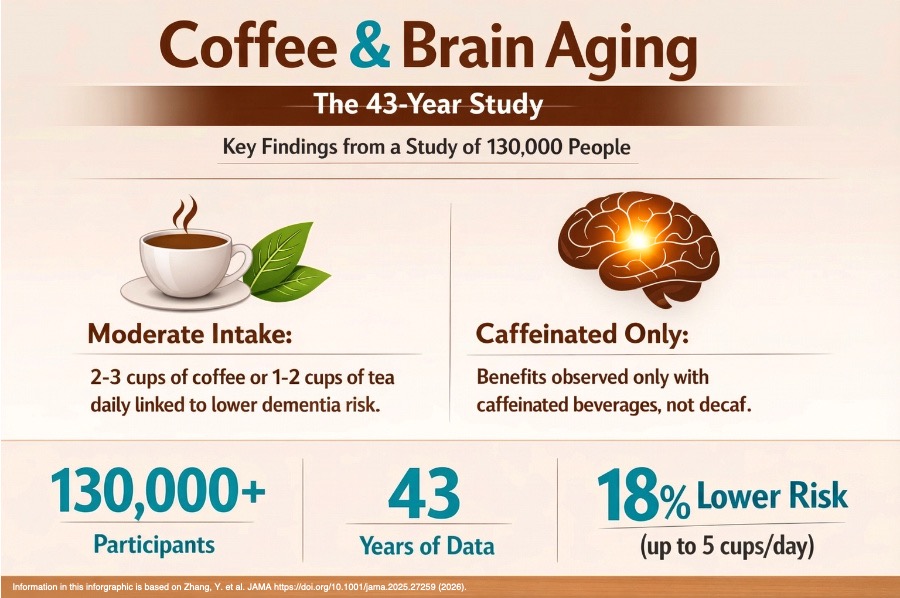
A 43-year study published in JAMA tracked over 130,000 healthcare workers and found your daily caffeine habit may protect your brain as you age. It's the longest study of coffee and tea's effects on cognition—nearly four decades longer than prior research.
Why it matters
Dementia risk dropped 18% among people drinking up to five cups of coffee daily compared to non-drinkers. That contradicts older research claiming heavy caffeine harms the brain.
The big picture
Moderate caffeine intake—two to three cups of coffee or one to two cups of tea—showed the strongest protection against dementia and mental decline. Even lower levels showed benefits.
Participants documented their diets every few years and completed cognitive tests requiring word-string recall (a standard memory-function measure).
By the numbers:
The study's scale makes it one of the most comprehensive looks at diet and brain health:
-
130,000+ participants from two long-term health studies
-
43 years of follow-up data
-
2-3 cups of coffee daily showed the strongest protective effect.
-
18% lower dementia risk in the highest consumption bracket
Yes, but
This is observational research—not a controlled trial. Researchers tracked habits but didn't assign people to drink coffee or abstain.
“This is a well‑conducted study for the type of data available. However, because it uses observational, not experimental, evidence, the findings can only be considered suggestive,” —Naveed Sattar, PhD, a cardiometabolic medicine specialist at the University of Glasgow, UK.
Translation: The research shows correlation, not causation.
The participants were healthcare professionals (nurses and doctors) with higher health literacy, better baseline health, and more consistent medical care than average Americans, limiting the findings’ applicability.
A closer look
Only caffeinated coffee showed benefits. Decaf drinkers saw no protective effect, suggesting caffeine drives the effect. That rules out other coffee compounds—like antioxidants—as the primary protective factor.
Lead author Yu Zhang (Harvard epidemiologist) told Nature that most prior studies lasted only a few years, too short to catch a disease that develops over 20 to 30 years.
Reality check
The study relied on self-reported dietary data collected years apart, creating a recall bias risk.
The bottom line
Your coffee habit likely helps your brain, or at least doesn't hurt it. But don't start pounding espresso shots as dementia prevention. The science isn't there yet.
Protect your hearing, preserve your connection
Age-related hearing loss doesn't mean losing your social world or increasing your risk of dementia. Our free 15-minute hearing screening will help you:
- Understand your current hearing health
- Prevent communication barriers
- Stay engaged with loved ones
- Maintain your quality of life
Schedule your free screening today and rediscover the sounds that matter most.
★ Call 708-599-9500 to schedule your free screening.
★ For facts about hearing loss and hearing aid options, grab your copy of The Hearing Loss Guide.
★ Sign up for our newsletter for the latest on Hearing aids, dementia triggered by hearing loss, pediatric speech and hearing, speech-language therapies, Parkinson's Voice therapies, and occupational-hearing conservation. We publish our newsletter eight times a year.
Don't let untreated hearing loss spoil your enjoyment of life.
Crest Hill, IL - 630-633-5060 | Palos Hills, IL - 708-599-9500